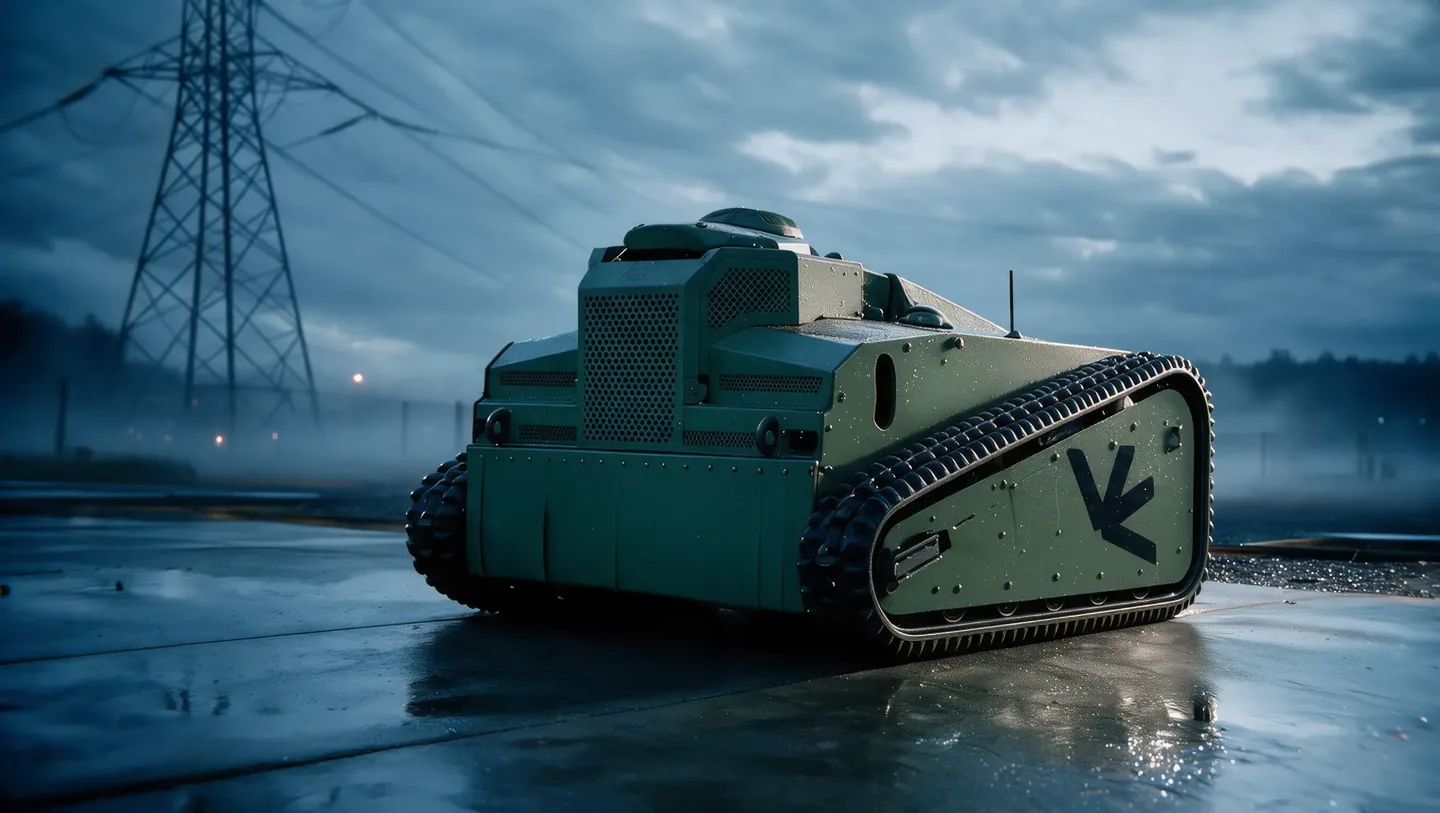
AITHEL UGV, 3D render, side view
Scroll
on board
275 TOPS
Edge Compute
per track
20 kW
Traction Motors
lidar
360 ° × 90 m
Perception Range
rated
−40 to +85 °C
Operating Range
Project: AITHEL UGV

Autonomous Ground Platform

Retrofit, Not Replacement

An existing mechanical machine becomes an edge-AI controlled autonomous vehicle without structural redesign. The kit provides servo actuators, traction drive, field I/O and a vehicle control unit built on the NVIDIA AGX platform.

The machine's original controls are actuated, not removed and re-engineered. Every stage is a working machine — no stage is a prototype.

Section 01 / Retrofit Path

Two Stages. Both Operational.

Stage 1

Teleoperation over 5G

≈ 2 days · host powertrain retained

VCU, auxiliary node and gateway go into the existing electrical bay, powered from the host 12 V bus. Four servo actuators replace the deck-lift, governor and blade-clutch linkages. The gateway taps the engine CAN, so rpm, temperature and hour meter reach telemetry unchanged.

Result: beyond-line-of-sight operation from a portable panel, with recorded sessions as training data.

Stage 2

Supervised Autonomy

electric traction · same VCU, same harness

Hydrostatic drive out, two 20 kW induction motors onto the existing sprocket flanges. The 48 V pack and BMS go into the front bay. Traction becomes a torque command — slope-aware traction control and precise skid-steer.

Result: one operator supervises several machines from a single panel. The safety loop stays hard-wired.
Section 02 / Perception

Overlap In All Quadrants.

A semi-solid-state 3D lidar on the front mast covers 360° to 90 m at 0.2° resolution — obstacle field, boundary and terrain classification. Four GMSL2 cameras add 120° front and rear and 90° each side, at 1928 × 1208 and 30 fps, over a 14 Gbps board-to-board link.

Slope-tolerant ground segmentation and foliage filtering reduce it all to a single obstacle cloud. Neural networks run hardware-accelerated on the machine itself.

3D lidar360° × 90 m · 0.2°
Camera front / rear120° · 1928 × 1208 @ 30 fps
Cameras left / right90° each
Camera link4 × GMSL2 · 14 Gbps
Plan view of the host machine showing 360-degree lidar coverage to 90 m and the fields of view of four cameras: 120° front and rear, 90° left and right.
Perception coverage · plan view · lidar 360° × 90 m, cameras 120° / 90°
Section 03 / Architecture

One Hub. Every Bus.

The vehicle control unit carries perception, planning, telemetry and an independent safety co-processor in one sealed box. All field I/O lands on a single 48-pin connector.

ComputeJetson AGX Orin 64 GB — 2048 CUDA, 64 Tensor, 2 × NVDLA · 275 TOPS
Motion busCAN-FD · CiA 402 · 8 Mb/s — deck lift, governor, blade clutch
Implement busCAN-FD, opto-isolated — host engine ECU, traction inverters
NetworkSix-port managed GbE — lidar, uplink, 5G, service port
Safety planeDual E-stop, radio-loss and tilt trip → traction disable. Hard-wired
Root of trustTPM 2.0, secure boot, separate watchdog processor
Right elevation of the host machine with AITHEL UGV kit devices placed and numbered: VCU, servo actuators, gateway, remote operator station, 3D lidar on the front mast, front and rear cameras, 5G and GNSS RTK, traction pack, E-stop loop.
Device placement · right elevation · numbered kit devices on the host machine
Section 04 / Software

Commanded By Hand, Voice, Or Map.

The machine follows a person, avoids obstacles and executes waypoint missions. It takes commands from hand gestures, a browser cockpit, or natural language by voice and chat.

Safety is structural, not conversational: motion starts only from a held idle state, and stop overrides everything. All motion converges into one mode-selected stream.

Live cockpitFull runtime graph in any browser, sub-second video
Gesture control23 classes, dual-hand, sliding-window vote
Operator identityHi-vis vest segmentation with tracked IDs
FollowingCamera–lidar fusion at 10 Hz or better
MissionsWalk-and-record waypoints, heading-gated
Ready To Discuss
Operational Requirements?
Get In Touch → info@mortar.eu